www.nspharmacy.ca, the official website of the Nova Scotia Pharmacy Regulator (NSPR), provides information about the pharmacy regulator, pharmacist and pharmacy technician registration, pharmacy licensure, and pharmacy practice in our province.

The information on this site is intended as a resource to pharmacy professionals and future pharmacy professionals, and to the public.

Public interpretation of health information on this site should not be substituted for the advice of a healthcare professional. For specific health matters, visitors to this site are encouraged to consult their pharmacist or other appropriate healthcare provider.

Occasionally, alternate websites are referenced on this site. This does not imply an endorsement by NSPR. The Nova Scotia Pharmacy Regulator does not endorse specific organizations, products, or therapies.

Nova Scotia Pharmacy Regulator is located in Mi’kma’ki, the ancestral and unceded territory of the Mi’kmaq People, and we acknowledge them as the past, present, and future caretakers of this land.

We respect and honour the Peace and Friendship Treaties that were signed in this territory, setting the terms of coexistence between settlers and the Mi’kmaq people. These Treaties remain in place today.

We recognize our responsibility to uphold the Treaties in the spirit of Reconciliation and collaboration. We acknowledge the harms that have created and continue to create health inequities for Mi’kmaq People, and we commit to moving forward in partnership.

We are all Treaty People.

We recognize the histories, legacies and contributions of African Nova Scotians, a distinct people with connections to the original 52 land-based Black communities. African Nova Scotians have been a key part of enriching the culture and history of Mi’kma’ki for more than 400 years.

Mi’kma’ki includes all of Nova Scotia, Prince Edward Island, part of New Brunswick, the Gaspé region of Quebec, part of Maine, and southwestern Newfoundland.

Concerns & Complaints

How We Handle Concerns and Complaints

Your trust is important. One of the critical roles the NSPR plays is to investigate and process information alleging professional misconduct, conduct unbecoming, professional incompetence, incapacity, and offences against the Regulated Health Professions Act and regulations by pharmacy professionals and pharmacy owners.

The NSPR is responsible for ensuring pharmacy professionals meet professional standards and practice ethically. When this does not happen, we are here to ensure that pharmacy professionals are held accountable for their actions.

If you are not satisfied with the pharmacy service you receive, you may want to first have an open discussion about your concerns with the pharmacy professional(s) involved and/or the pharmacy manager of the pharmacy. Open communication of any concern involving a professional service often results in a satisfactory resolution of the problem.

However, if this doesn’t resolve your problem, or if you cannot discuss your concern with the pharmacy professional(s) or pharmacy manager, or if you believe it is of a serious nature and should be brought to the attention of the NSPR, you can contact the NSPR Professional Conduct Team for assistance at 902-422-8528 ext. 234 or complaints@nspharmacy.ca.

Note: By contacting the NSPR, you are not automatically filing a complaint. The NSPR primarily investigates complaints related to a pharmacy professional’s practice. Concerns about business policies and practices should be discussed with the pharmacy manager, pharmacy owner, or head office in the case of a pharmacy chain.

You can file a complaint with the NSPR in a number of ways:

  • Emailing or mailing the NSPR Professional Conduct Team
  • Calling the NSPR Professional Conduct Team

What to include:

When making a complaint by email or mail, be sure to include:

  • your name, address, and telephone number;
  • the name of the pharmacy professionals(s) involved (e.g. pharmacist, pharmacy technician, student, intern, candidate.);
  • the name and address of the pharmacy involved;
  • a description of the events that led to the complaint, including date(s); and
  • copies of any documents that support your complaint.

Contact

You can reach the NSPR Professional Conduct Team by:

Email
complaints@nspharmacy.ca

Phone

902-422-8528 ext. 234

Mail

Professional Conduct Manager
800 – 1801 Hollis Street
Halifax, NS
B3J 3N4

It is better if a complaint comes from the patient or somebody directly involved with the issue; however, anyone with a connection to the patient, pharmacy, or pharmacy professional may complain for the patient.

A complaint can be filed with the NSPR Professional Conduct Team whether the patient in question is alive or deceased.

Complaint information is kept confidential using a number of security measures within the NSPR. As well, NSPR staff and committee members (Complaints Committee, Fitness to Practice Committee, Professional Conduct Committee) enter into confidentiality agreements with the NSPR.

The Complaints Committee oversees the investigation of a complaint and decides whether the complaint should be forwarded to the Professional Conduct Committee for a full hearing. The Complaints Committee meetings are not open to the public and its discussions and findings are confidential.

Hearings are usually open to the public, although either the complainant or respondent can request a closed hearing. The Professional Conduct Committee may grant this request if the information that would become public is of a sensitive nature. Similarly, while hearing decisions are published, a publication ban may be imposed on portions of the evidence and the decision when appropriate. Hearing decisions do not usually identify patient names.

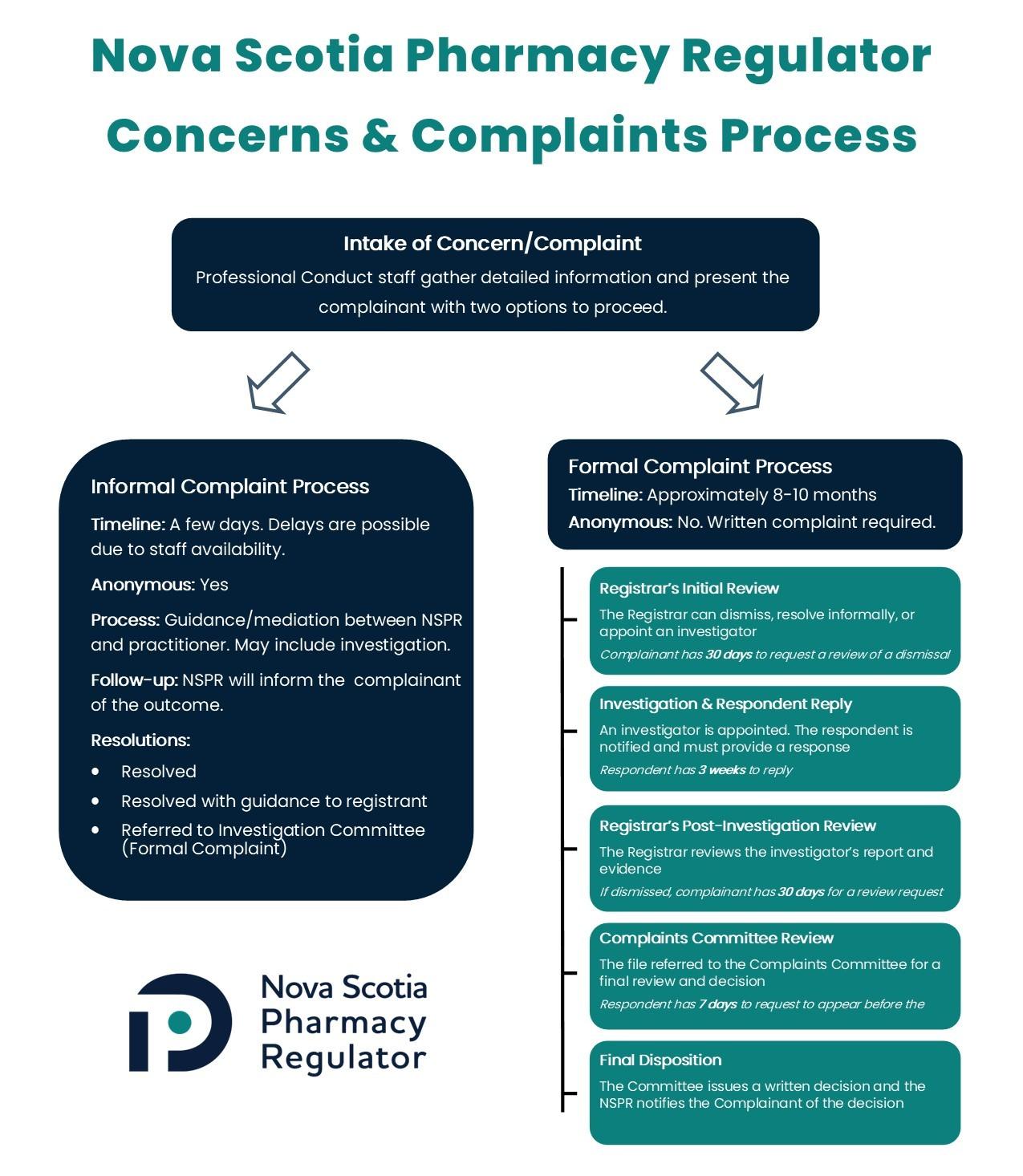
The NSPR will do an initial review of the matter and determine whether it should be dismissed, resolved informally, referred the matter to Fitness to Practice or investigated.

If an investigation is warranted, the pharmacy professionals involved in the matter will receive a copy of the complaint and be asked to provide a response. The investigation will follow, and the results will determine whether the matter should be referred to the Complaints Committee or whether it should be dismissed or resolved via informal resolution. You may be contacted for further information during the course of the investigation.

If the matter is dismissed by the NSPR prior to a referral to the Complaints Committee, the complainant may, within 30 days of dismissal, submit a written request for review.

If the matter is referred to the Complaints Committee, the complainant will be notified of this referral. After the Complaints Committee has reviewed the matter and issued a decision, the complainant will be notified of the decision.

After a thorough examination of the information gathered with respect to the investigation of a complaint, the Complaints Committee will make one or more of the following decisions:

  • Dismiss: It may dismiss the complaint and provide any guidance the committee considers useful to the complainant, the respondent or any other person associated with the complaint if the committee determines that:
    • (i) the complaint is outside the jurisdiction of the regulatory body,
    • (ii) the complaint cannot be substantiated,
    • (iii) the complaint is frivolous or vexatious,
    • (iv) the complaint constitutes an abuse of process,
    • (v) the facts alleged, even if proven, would not constitute professional misconduct, conduct unbecoming the profession, incompetence or incapacity, or would not merit a caution, or
    • (vi) the processing of the complaint would not advance the objects of the regulatory body
  • Informal Resolution: The NSPR may informally resolve the complaint, including authorizing the respondent’s resignation from the register and any relevant category of licensing.
  • Caution: The Complaints Committee may caution (warn) the pharmacy professional if the Committee determines that the pharmacy professional has breached the standards of professional ethics or practice, but in consideration of the circumstances, agrees that it does not constitute professional misconduct.
  • Consent Reprimand: With the respondent’s consent, the Complaints Committee may order that the respondent receive a reprimand and that the reprimand be communicated to the respondent, the complainant and any other person the Committee considers appropriate.
  • Conditions/Restrictions: With the respondent’s consent, the Complaints Committee may impose conditions or restrictions, or both, on the respondent’s registration or licence.
  • Hearing: Where a determination is made that the matter warrants a hearing, the Complaint’s Committee may refer the matter to the Professional Conduct Committee.

  • Fitness-to-Practise Referral: Where the matter may involve incapacity, the matter may be referred to the fitness-to practise process.
Hearings

The Professional Conduct Committee is a committee appointed by the board of the NSPR and is comprised of pharmacists, a pharmacy technician as appropriate, and members of the public.

The Professional Conduct Committee resolves matters referred to it by the Complaints Committee, and this could involve conducting a hearing – a formal process similar to a trial. When a complaint proceeds to this level, you are no longer the complainant (the NSPR becomes the official complainant), but you may be called to testify as a witness. If so, the NSPR’s staff and lawyer will help you understand the process.

The Professional Conduct Committee will hear both sides of the case and will make a decision. It may dismiss the charge(s) or, if it decides that professional misconduct did take place, it may take various actions against the pharmacy professional including to suspend or revoke their licence, restrict their right to practice, impose a fine, and/or issue a reprimand.

In most instances, the matter referred to the Professional Conduct Committee may be resolved with a Settlement Agreement between the NSPR and the pharmacy professional. A Settlement Agreement includes an admission by the respondent as well as the respondent’s consent to a specified disposition. It must still be approved by a Professional Conduct Committee, but it eliminates the need for a formal hearing.

The NSPR (including the Professional Conduct Committee) does not have the authority to order financial compensation for any harm that may have been done, or to direct how a pharmacy owner disciplines an employee.


There is no set time limit for resolving a complaint, as the length of an investigation varies with the complexity of the complaint. The NSPR takes a complaint seriously and makes every attempt to resolve it in an efficient manner while ensuring that a full and complete examination of the information is undertaken.

The NSPR will notify you in writing of the outcome of your complaint.


Fitness to Practice Process

The Fitness to Practise (FTP) process is one part of the NSPR’s professional conduct process. It is a consensual means of dealing with matters involving the possible incapacity of a pharmacy professional when it is determined to be consistent with the public interest being served.

If you have any questions about the FTP process, or for more information, please contact the Nova Scotia Pharmacy Regulator: Professional Conduct Manager, 902-422-8528 x 234 or complaints@nspharmacy.ca.

The NSPR must determine, in accordance with the Regulated Health Professions Act and regulations and in a manner consistent with its mandate of protection of the public interest and with the professional conduct process, whether it is appropriate for the pharmacy professional’s possible incapacity to be dealt with by the FTP process.

The FTP Committee will, depending on the circumstances, determine whether one or more of the following actions should be taken:

  • ordering an assessment of the pharmacy professional’s capacity;
  • assessing the treatment and steps necessary to address the pharmacy professional’s incapacity; and
  • developing and subsequently monitoring compliance with an Interim and/or Remedial Agreement, which may include conditions or restrictions on a pharmacy professional’s licence or an undertaking by the pharmacy professional not to practice pharmacy.

Participation in the FTP process is voluntary and consent of the pharmacy professional is required. The consent of a pharmacy professional, once given, may be withdrawn at any time, though not retroactively, upon which the matter would be referred back to the referrer (i.e., the Registrar or the Complaints Committee).

However, even if consent is not withdrawn, the FTP Committee may refer a matter back to the Registrar or Complaints Committee if the FTP Committee concludes that a pharmacy professional’s continued participation in the FTP Program is no longer in the public interest, if the FTP Committee believes that facts exist that, if proven, would constitute a complaint, or if the pharmacy professional is in breach of any terms or conditions considered appropriate and recommended by the FTP Committee.

If you have a concern about a pharmacy professional’s fitness to practice, you can contact the NSPR Professional Conduct team for assistance at 902-422-8528 ext. 234 or complaints@nspharmacy.ca.